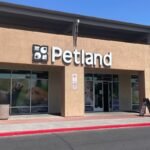
Paws and Whiskers Pet Shop
4601 N. Rancho Dr
Las Vegas, NV 89130
(725) 310-6677
Date and time of CAPS investigation: 6/24/25; 7:08 pm PST
Approximate number of puppies observed at time of investigation: 14
Puppies were in open-top enclosures on the floor, with discarded newspapers covering the enclosure floor. There were two puppies in each enclosure. No breeder information or information about the individual dogs was posted anywhere, nor was the sign required by Nevada law informing consumer that information about the dogs’ source, health, and background was available.
The store floor consisted of two rooms, one large room at the front, and a smaller room in the back. Both rooms had enclosures with puppies in them, but the front room had other goods for sale, while the back room had stacked individual steel cages for the dogs to sleep in. The store itself had a variety of breeds, some of which were a Dachshund, Chihuahua, Cavalier, King Charles Spaniel, Pomeranian, Poodle, Corgi, and Shetland Sheepdog (Sheltie). Dogs ranged in price from $950 to almost $3,000.
I was let into the store and interacted with one of the store owners, a mid-30s looking Hispanic man with shoulder-length hair, a mustache, chin beard, and glasses named Gonzalo. Gonzalo informed me that they get puppies around eight or nine weeks of age and cannot get them younger. He shared that they come from various states, such as Missouri, Indiana, and Colorado (he did not mention any other states).
Gonzalo continued that all of the dogs come with certification and pedigree, a free first vet exam, vaccines appropriate for their age, microchip, and 10-day illness warranty.
Gonzalo went into the back of store, leaving me with the other owner, his wife Sam, who had long hair tied in braided ponytail and glasses. I spoke with her about the puppies. She repeated what Gonzalo told me about what comes with the puppies, but she also noted that puppies costing more than $2,000 came with a one-year congenital and hereditary warranty. This would cover the amount of treatment up to the cost of the puppy. If the puppy passed away, the pet shop would give the customer another puppy. She also added that if I wanted the warranty for a puppy priced below $2,000, I could pay an additional $2,000.
I selected brown and white Cavalier puppy to play with in the smaller room, After playing with the puppy, I went to the front counter to speak with Gonzalo about purchasing the puppy. We discussed financing, with Gonzalo telling me they use a company called Easypay. He explained that they do 24 monthly payments with interest, “but we don’t recommend it because it’s really high interest.” He suggested instead a current promotion consisting of 90-day interest-free loan and a $40 loan fee. The loan would be deducted from my bank account automatically into six payments.
Gonzalo showed me the dog’s first exam results, the vaccine history, the American Canine Association registration, the pedigree, and breeder information. He stated, “We like to work with certified breeders. They are the best ones.” He explained that “those ones are taking classes. They don’t breed the dogs more than, I think, twice. And they really take good care of them. They have to play a certain amount of hours with dogs every week. They’re really, really well taken care of. And they’re the best breeders that are out there. So, we’re trying to bring breeders, the puppies [from a] certified breeder, but not all the breeders have them.”
I asked Gonzalo if they’ve ever visited the breeders, and he said while they wanted to go and the breeders have even invited them, they have never been due to distance constraints. He did say, however, they know the breeders and try to have a good relationship with the breeders. I asked if they buy from puppy mills, and he replied that not only are puppy mills illegal but they “cannot buy any puppies that are not USDA-certified. So, for us to buy a puppy, the breeder has to have his license. And they get inspected, I think, every month. The doctor from the USDA has to inspect the facility every month, inspect the puppies, and all that.” He added his store was also trying to get licensed by the USDA so it could sell and ship puppies around the country.
I shared my concerns around the origin of the puppies. Gonzalo said they have pictures and even QR codes that show where the dogs from. I continued looking at paperwork, which showed the breeder was Marvin Nisley. I also saw a pedigree that went back four generations. I confirmed again whether the USDA inspects every month, to which Gonzalo replied “almost every month. The thing is, they don’t let them know when they’re going to inspect. It’s random inspection. So, they caught them off guard.” He then added that they have indoor/outdoor access and some even had acres of land and playgrounds.
Gonzalo stressed that they “try to not work with puppy mills.” The mentioned that here’s a list that’s called The Horrible 100 and the store is checking all the time to ensure breeders they work with were not on the list. I was able to capture the broker information on the health record. I asked again how many times their breeders use their female dogs for breeding. Gonzalo noted while there are breeders who let their female dogs have six litters, “there’s a lot of regulations to have that paper.” He was most likely referring to the Canine Care Certified program run by Purdue University, which he said he thought allowed dogs to be bred only twice.
Breeder and broker names obtained during investigation
Marvin Nisley, 777 Patriot Rd, Gallipolis, OH 45631, 31-A-0802, 177 adults and 62 at 3/18/25 USDA inspection; 180 adults and 92 puppies at 10/3/22 USDA inspection; 158 adults and 138 puppies at 10/6/21 USDA inspection. Between 2022 and 2025, USDA did not inspect Nisley’s facility for 2.5 years, which is especially concerning because of the large number of dogs and puppies.
Preferred Canine, 29952 CR 10 29939 CR 10, Fresno, OH 43824, 31-B-0194
Broker names obtained from 2025 Certificates of Veterinary Inspection
Preferred Canine LLC, PO Box 336, Sugarcreek, OH, 31-B-0194; physical address: 29952 CR 10, Fresno, OH (residence of Abe Miller, which is listed as an agricultural property under county tax records), 14 puppies at 12/19/24 USDA inspection
The owner of Preferred Canine is Abe Miller in Fresno, Ohio. Miller has a long history of selling sick puppies, violating the Animal Welfare Act, and being the subject of lawsuits.
Every time, Miller is in trouble, he changes the name of his facility. When Sarasota County held a hearing for the ordinance banning the retail sale of dogs and cats in January 2016, he testified against the ordinance, using the kennel name of Quail Creek. Certificates of Veterinary Inspections over the last few years showed him using the names, Comfort Canines and Holmes for Canines. Miller hired a bus to transport at least 30 of his Amish breeders to testify against the ordinance, which passed in January 2016.
The dogs he brokered included those with the campylobacter virus that made dogs and people ill in the outbreak at numerous Petland stores.
Miller also owns Golden Seal Puppies, a brokerage facility operating from his adjacent property.
J.A.K.’s Puppies, Britt, IA, 42-B—0271, 76 puppies at 12/16/24 USDA inspection
CAPS Investigator’s Journal: The Truth Behind J.A.K.’s Puppies
Pinnacle Pet, Neosho, MO, 43-B-3871, 138 dogs and 29 ferrets at 8/18/25 USDA inspection. Pinnacle’s owner claims he runs the largest brokerage facility in the country. Pinnacle owns Puppy Travelers.
Blue Ribbon Puppies, Odon, IN, 32-B-0238, 37 puppies at 4/9/25 USDA inspection
CAPS Investigator’s Journal: The Truth Behind Amish Puppy Mills
First Class Puppies. Bluejacket, OK, 73-B-1866, 5 adults, and 45 puppies at 7/23/25 USDA inspection. Violations included not providing adequate space and exercise and not having an exercise plan.
Tiffanies, LLC, Frankford, MO, 43-B-3731, no puppies at 10/30/23 USDA inspection. This broker has not had a USDA inspection in more than two years. Tiffanies was listed on deposition documents as supplying puppies to Pet Connect Rescue, the fraudulent rescue created to circumvent laws banning the retail sale of puppies and kittens.
QD Kennels, Frankfort, MO, 43-B-3773, 38 puppies at 6/28/24 USDA inspection
Conrad’s Cuddly Canines (Curt and Lori Conrad), Frankford, MO, 43-B-3659, 20 puppies at 8/23/25 USDA inspection
Breeder names obtained from 2025 Certificates of Veterinary Inspection
Kevin Street, Bowling Green, MO, 43-A-548, 149 adults, 49 puppies, 27 cats, 43 kittens at 9/30/25 USDA inspection. During this inspection, the inspector found four violations: a dog housed inside a building without a primary enclosure, where she was could come into contact with electrical devices, such as a heater on the floor, exposed electrical cords, items on shelves that could fall of, and a trash container; mother of newborn puppies housed with another female dog, who could potentially attack the puppies; 57 adult dogs past due on parvovirus/distemper vaccinations; and uncovered trash container in a dog building. While the improperly housed dog and outdated vaccinations had correct-by dates of 10/14/25, the inspector did not return to Street’s facility until 12/17/25, when the inspector was unable to do an inspection because Mr. Street was not home, and he did not authorize an employee to accompany an inspector. The inspector cited Street under 2.126 (b) (access and inspection of records and property).
Landon Headings, Buffalo, MO, 188 adults and 145 puppies at 12/4/24 USDA inspection
Evidence contradicting statements made by the employee
The employee stated that the store works with only the best certified breeders, the ones taking classes, that don’t breed their dogs more than twice, are required to let them play a certain number of hours and take really good care of their dogs.
This information is misleading. The store mostly obtains puppies through USDA-licensed brokers, including J.A.K.’s Puppies, Blue Ribbon Puppies, and Pinnacle Pet. CAPS has made video exposes about these brokers after having investigated them and some of the breeders who sell to them. All of these breeders were puppy mills. Preferred Canine has a long history of problems, as stated above. The puppy I played with was bred by Marvin Nisley, but he sold the puppy to Preferred Canine, who has the relationship with the store. Nisley had 239 dogs and puppies at his last USDA inspection; USDA hadn’t inspected him for 2.5 years before his 2025 inspection.
Pinnacle Pet has some breeders who participate in the Canine Care Certified Program, which does require better conditions for breeding dogs, but this program does not require a certain number of hours of exercise or that dogs be bred only twice. The dogs are still being bred in livestock-like conditions. They aren’t running around on acres of land and playing on playgrounds as claimed by the employee. While CAPS investigators have seen a few play areas for dogs, we have yet to witness them being used. He also claimed the dogs have indoor/outdoor access. Most of these dogs are bred in the Midwest, which has very cold winters. USDA regulations require either access to indoor housing or sufficient shelter from inclement weather. Indoor housing does not mean the dogs live inside a house. They are living in small enclosures with access to wire enclosures or enclosed runs.
The employee’s stated that the store knows the breeders and tries to have a good relationship with them. Paws and Whiskers obtains most of its dogs from a number of largescale brokers, as stated above. The store does not have a direct relationship with the many breeders who sell to these brokers. In addition, the same breeders’ puppies are not ending up in the store on a regular basis since these brokers work with pet shops all over the country. The breeders who sole directly to the store (names appeared on CVIs) were Kevin Street, whose CAPS investigations proves he runs a puppy mill, and Landon Headings, who had 333 dogs and puppies at his last USDA inspection. The number of dogs alone indicates that Headings runs a mill.
The allegation that not only are puppy mills illegal but they “cannot buy any puppies that are not USDA-certified is false. USDA licensed facilities are puppy mills. In addition, brokers can buy from unlicensed breeders, who don’t need a USDA license. USDA only requires a license when a breeder has at least five breeding females; there is no cap on the number of males or puppies.
The employee’s statement that for the store to buy from a breeder, they need a license is also untrue since Paws & Whiskers obtains most of their dogs from brokers who select their breeders, and these breeders, as stated above, aren’t necessarily licensed.
His statement that he thinks the breeders get inspected monthly is completely false. USDA does annual inspection, and often will go longer than that, as stated above for Marvin Nisley. He alleged that “the doctor from the USDA has to inspect the facility every month, inspect the puppies, and all that.” While USDA has Veterinary Medical Officers (VMOs) who do USDA inspections, most of their inspectors are not veterinarians.