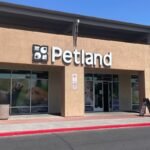
Petland Overland Park
7911 W 151st St
Overland Park, KS 66223
(913) 402-4583
Date and time of CAPS investigation: 08/14/21; 1855
Approximate number of puppies observed at time of investigation: 50
Employee “really good friends” with puppy miller
There were 22 puppy enclosures in the store, with one to three puppies each. The enclosures were made with solid walls, cage-like back doors for workers to access the puppies, and bare plastic cage floorings. Water bottles were attached to the cage doors. An employee (Caucasian male, about 30 years old, 6’00”, 180 lbs., with short blonde hair, who identified himself as Zach) showed me a Cavalier puppy. When I asked for information on the puppy, Zach immediately got the dog, including information showing that the puppy was bred by Sheree Bonnette in Chillicothe, MO, with no USDA license number provided. I asked another worker, unassociated with selling puppies, for information on a Pomeranian. The worker immediately got that dog, showing the breeder as Cloveridge Kennel, PO Box 93, Corydon, IA 50060. The worker also immediately provided paperwork on a Frenchie, also bred by Sheree Bonnette in Chillicothe, MO.
I asked the non-puppy worker about breeders, and he reiterated that he doesn’t work with the puppies but that the top 5% of breeders are used, and that they are all USDA licensed. He then referred me to Zach for more information. Zach said that many of the store’s breeders are in Iowa and elsewhere in the Midwest, and he claimed that he’s “really good friends” with the breeder Sheree Bonnette.
“Immaculate” kennels with open yards
I asked Zach about specific breeding conditions, telling him I didn’t want to buy a puppy from a puppy mill. He said, “Yeah, obviously. I know there’s a lot of that, that kind of goes around online. It’s really unfortunate, because that’s not the case at all.” He said the store’s breeders are mostly Amish, with high standards and kennels that are all very clean. “The quality of standards they have, it’s insane. Like if I ran my finger along the top of a unit, I would never be able to find anything. There was no dust, no filth, nothing. It’s like they’re absolutely immaculate.” He then showed me videos and pictures on his phone of dogs with large kennels and open yards to run in. I noted a facility in the video as Waggin’ Tails, which the employee said is in Iowa. Zach also said that the kennels are inspected by five different groups or agencies a year, including the USDA. As we looked at videos and pictures, the employee said that the images were “the standard for how they run their facilities.”
Worker describes dog paradise for breeding dogs
I asked what the “top five percent of breeders” meant, and he responded, “So that goes into, what we’re talking about the health and genetics of these dogs, as well as these type of facilities that they run. These aren’t cheap facilities; it takes a lot of money to provide a facility like that. And then also going through those five inspections. I didn’t even finish those. They’re federal inspected with the USDA, they’re state inspected which is where they live. Whether that’s Iowa, Minnesota, Missouri, wherever they’re at. They’re also independently inspected by AKC. The American Kennel Club goes and inspects them. They’re vetted and then inspected. So the veterinarian’s going into the facility all the time to check on the puppies. Basically, on a more, more often, once a week basis. ‘Cause they’re going in, checking on the puppies, checking on the facility. And then we get the privilege to go ourselves and make sure everything’s up to our personal standards.”
He then added, “And then as far as what they do for like health and genetics of those dogs, they do a proper health testing on those parent dogs, make sure they’re genetically clear of health issues. Producing the most quality puppies possible. So, the puppies they’re getting, they’re paying a lot of money for, having that health in the puppy invests in that. Also, like temperament, something that is hardly genetic, having those dogs that are really well socialized, having that great genetic temperament. You breed two of those together, the puppy’s going to be having the best temperament possible.” He then claimed that the store’s breeders handle their puppies more often than other breeders do, helping to socialize them.
I again asked him to clarify the “top five percent” remark, and he gave a vague answer about using “top tier” breeders without quantifying it in any way. He told me that inspections are done at random times of the year, and added, “As far as how stringent those inspections are, there’s two examples I can give you. If this were a trash can, a piece of trash is sticking out of it, that’d be a violation. So, things like that. If there’s a water bowl, and there’s any kind of debris in it, whether it be poop, whether it be food, whether it be dirt, also a USDA violation.”
Claim that breeders exceed USDA guidelines for space and breed just a few times
Zach claimed that female dogs are typically bred two or three times, and that there’s a waiting list of people who want to rescue breeding dogs being given away, while others are kept by breeders as pets. He said female dogs are often retired at four years of age, and he claimed that the store’s breeders will exceed USDA guidelines for space.
Evidence of false statements and misrepresentations of breeders by store
The employee’s claim that the store buys from the top five percent of breeders is false. No such ranking system exists within the USDA.
The employee’s claim that breeders breed female dogs two or three times and retire them is false. Dogs are bred as much as possible, typically for five to six years. Many breeders can’t find homes for their dogs and have them euthanized.
The employee’s claim that breeders have weekly checks from veterinarians is false. I worked undercover at a USDA-licensed brokerage and breeding facility in Minnesota in 2008, and puppies were only vet-checked when they were shipped to stores. In addition, veterinary information for puppies at all stores, including Petlands, shows that puppies are checked when they are going to leave the facility, but not on a weekly basis.
The employee’s claim that a piece of trash sticking out of a trash can is a USDA violation is incorrect. His claim that debris in a water bowl is a USDA violation is incorrect. For dirty conditions, the USDA uses “teachable moments” to avoid citing breeders for violations.
The employee’s claim that breeders exceed USDA requirements for space and have open yards for dogs is a lie. I documented the breeder Sheree Bonnette in 2022, and I saw dogs living in and walking in circles inside elevated wire cages. No dogs were in yards of any kind, and the cages were so small that the dogs could only take a step or two before having to turn around.
Breeder information obtained during store investigation
Sheree Bonnette, Chillicothe, MO, 43-A-215, 144 dogs and 49 puppies at 8/10/21 USDA inspection
Marvin Mullet/ Cloveridge Kennel, PO Box 93, Corydon, IA 50060, 42-A-1515, 75 dogs and 51 puppies at 2/11/21 USDA inspection
Waggin’ Tails, IA (unable to find information on this breeder)